Are you over 40? Have found yourself groaning as you got out of a chair or picked something off the floor?
Do find yourself always rubbing your sore knees?
Complaining about your lower back?
Feel like your ankles are set in concrete?
That years of wear and tear have beaten you up?
A combination of being fit and active. Going to the gym 4+ times a week. But then sat at a desk and on the sofa for 10+ hours a day.
Well, it’s taken its toll.
This was me at the ripe old age of 31.
It felt like my lower back was made of glass. My knees were OK but were becoming a little sore. My ankles hurt after 15+ years of playing football every week.
But all was not lost.
One simple change improved all 3 issues.
Barefoot Running
It seems every week I see a new company that is promoting their new “barefoot” style footwear.
This wasn’t the case back in 2012.
I found two brands that made barefoot running shoes.
So why are barefoot running and minimalist-style footwear becoming so popular?
Back in 2012. I read a book called the “Primal Blueprint”. Its main focus was on diet and exercise. However, a small section discussed wearing minimalist and barefoot types of footwear.
Why?
Well. The idea. Which I love by the way. Is to look at how humans have evolved, which has taken over 100,000 years.
That modern life. Diet, exercise trends, footwear and clothing aren’t enhancing what we already have. It’s working against it.
That our bodies, more so our feet have evolved to be able to run, walk, jump and move.
Parts of our body, like our Achilles tendons are natural shock absorbers. And this tendon takes a lot of the stress when running.
Heal-Toe Running Is Unnatural.
If you go into any running shoe shop. And take one of their examinations.
They will want you to run, landing on your heel, then onto your toes to push off. To look at how you land to decide what type of “support” you need.
Instep, outstep, neutral. The heel size you’ll need on your running shoes.
We go on their advice, thinking they know best.
But all modern running shoes do is “switch off” our natural support system.
Most running shoes stop you from running on your toes. Which is our natural way of running.
They also “trap” your feet into a constricted position. Stopping the foot muscles from working, developing, and getting stronger. Stop them from getting used to different terrains.
Finally, because your feet always land in this heel-toe position. Your feet slope forward at all times. With the heel of the shoe taking a lot of the impact.
This switches off the Achilles tendon. Making it shorten, even stop working altogether.
What I’m getting at, is these so-called ‘perfectly’ designed shoes. Stop your natural “shock absorber” from working, developing, and strengthening.
From doing what they have evolved to do.
The Benefits of Barefoot Running for the Over-40
There are so many benefits. And I’ll talk about the huge benefits I’ve seen later.
But there are 4 that come to mind straight away
Improved Foot Strength and Flexibility
I’ve been chatting about the feet already. And it seems obvious that it’s all about the feet.
But I’ll stress it even further.
What I’ve found over the last 15+ years of injuries. That your muscles are all interlinked. Knee or ankle pain? This could be a tight muscle above or below it.
Or could be that you’re very weak in certain muscles or tendons. Even in your feet and ankles.
Also, all your nerves end in your feet. Funny that?
If that is the case, we’ve evolved that way. It doesn’t make sense to switch off the muscles and tendons in the feet. That will send messages back to the brain and the rest of the body.
That if we improve the strength and flexibility in our feet. In the muscles and tendons in those body parts.
This will help further up the legs and into the lower back.
That our internal “messaging” system will get switched on again.
Enhanced Proprioception and Balance
What the hell does proprioception mean?
Well, I’ve touched upon it.
It’s your body’s ability to sense movement, action and location. And it’s present in every muscle you have.
So again. If your foot muscles are weak. And are not activated or used as they should be. Then your body isn’t sensing what it needs to.
One of the biggest causes of injury in the over 60’s is losing balance. Falling and then injuring themselves. Either by hitting something or the impact of landing on the floor.
So. With 20 years still in the bag! Why not improve your balance by improving not only your foot strength? But your body’s ability to “sense” uneven ground or if you’re going to lose your balance.
There are a lot of studies that have looked at longevity and it links to things like grip strength. But also balance.
It could be down to being stronger for longer. This improves balance and reduces the risk of injury from falling.
Barefoot shoes do this by making you engage with the ground more.
Potential Reduction In Joint Stress
This will sound counterintuitive.
But if you wear these “supportive” designed running shoes. Tailored to your feet and running style.
The impact, the “shock” from when your foot hits the ground. This force still has to go somewhere.
For me, that was my ankles from playing football. A bit on my knees. But also a lot of issues with my lower back.
Think about it.
If the force of landing, goes through the shoe bypassing your feet and all its years of evolution. Missing out the natural shock absorbers. It has to go somewhere.
It does, by shooting up your legs.
Going barefoot reduces the stress on the joints further up the legs and lower back. Because the bones, muscles and tendons absorb a lot of the force.
What they evolved to do.
Mental Health Benefits and Connection With Nature
I’ve seen a lot about grounding recently.
That one of the best ways to start the day is to go outside, barefoot. And stand on the earth, grass, soil, whatever. And ground with the earth’s magnetic force.
That’s very interesting to me.
But why stop there?
Yes, we can’t walk around in the modern world completely barefoot.
With tarmac, concrete, litter, and broken glass. It would be risky.
Not to mention the funny looks you would get.
But the sensation of clambering over rocks. Feeling gravel under your feet. Letting your feet use their full range of motion outdoors.
It helps you connect more with nature.
Something we are finding is far better for our mental health and taking 87 pills each morning.
Debunking Myths About Age and Barefoot Running
I can hear you saying
“It’s too late to start”
“Older feet need more support”
“It’s just a fad”
I’ve already touched upon that loss of balance in the over 60’s is a major issue. A massive root cause for injury.
So if you think it’s too late to start? Well, you’ve at least 10, maybe 20 years to put that right.
To improve foot strength and balance.
As with most of our other body parts too. As we age we need to focus on maintaining strength, mobility and increasing flexibility.
Not more support.
90% of your waking hours. Your feet will be in contact with the floor. Carrying your weight. Like a car, they need regular maintenance.
Not taken off the road completely. In a “supportive” shoe that is making things worse.
Preparing Your Body for Barefoot Running
If you’ve got this far.
I hope I’ve convinced you to give barefoot running, and the barefoot lifestyle a go.
But before we dive in.
It makes sense to do some prep work.
Not only will this help you start with barefoot running. But will improve your foot and ankle strength in the long term too.
So, how to get started?
Foot Strengthening Exercises
First, we need to start strengthening our feet.
If you’ve spent 30-40 years in so-called supportive footwear.
This is a must no matter if you choose to completely embrace the barefoot lifestyle or not.
This article is a great place to start: 9 Exercises For Foot Strength & Flexibility.
Improving Overall Flexibility
This ties into the resources I’ve linked to.
You will need to improve your foot and ankle flexibility. Because these body parts will start becoming more engaged than ever before.
And the main issue with 99% of the footwear out there. Is that it decreases flexibility in your ankles.
So you need to improve this before going all in. Here’s a great video on the importance of ankle range of motion.
Core and Lower Body Strength Training
I’m not going to lie to you.
When you first make the switch. You’re lower body, your legs, more specifically your calves are going to take a battering.
So you need to focus on core and lower body strength training.
One of my favourite exercises to help with this is the stair calve raise exercise.
Start by standing on the first step of your stairs, or any flight of stairs.
Keeping the ball of your foot on the stair, let your heel drop down below the step. Then press up as high as you can.
You can start with both feet on the stairs and work both calves at once. Then move onto single leg raises.
What I like to do is pause at the bottom of the exercise. With my toes pointing upwards. This gives a good stretch of the calves and legs.
Also on pause and hold at the top of the motion too. Making your calves work that little bit extra.
Getting Started: Your First Steps into Barefoot Running
OK.
You’re ready.
Let’s start getting into barefoot running.
Proper Form and Technique
Depending on your current running level. And how fast you already run. This may be easier for you.
But a lot of these “Running Shoe Shops”, look at heel-toe running.
That’s wrong.
Do you ever remember running as fast as you can as a kid, completely barefoot?
Or if you watch the great sprinters or long-distance runners.
What you’ll notice is they run on “their toes”. On the balls of the feet 99% of the time.
The heel doesn’t get involved at all.
So when starting. Focus on trying to run on the balls of your feet and “on your toes”.
Don’t worry about times or the pace you are running.
Trust me, that will come later. Within a few weeks, you’ll notice the pace will go up and you won’t be exerting as much energy.
Why?
Because it’s a more efficient way of running. You’re tapping into your evolution.
The way you’re meant to run
Start with Short Distances and Increase
Please don’t do what I did.
At the time of switching to barefoot running. I was doing a lot of 5 km runs during the week. As fast as I could. Also a 12 km run on a Sunday.
And I went off and tried doing a normal 5 km run.
After 2 km my calves felt like concrete. Completely tight and felt overworked.
It’s because my feet, ankles and calves had never worked so hard.
I ended up walking the rest of the way
Oh, and because I’d done ZERO prep work.
Learning from this, that’s why I’ve included a prep section in this article.
So when starting out I recommend dropping the distance and pace you run at. What you’ll find in a short period of time. Your pace will increase on its own.
Then you can focus on getting back to the distance that you want.
Another good technique that I like and have used. Is to run for a set distance. Say 1 KM, then walk for the next 1 KM. It gives your body a break while still completing a distance that you may have set.
Listening To Your Body and Pace Yourself
Again. Going back to my own experience.
If you end up with tight calves or legs. Or it feels like your feet are taking a battering.
That’s OK.
Your body isn’t used to it, YET.
Back off. Focus on flexibility, mobility and strengthening exercises and try again in a day or two.
Essential Gear for Barefoot Running
If you’re an avid runner already.
You will have everything you need. Apart from the barefoot running shoes of course.
Minimalist Shoes vs. Truly Barefoot
There are in fact two ways to get started with barefoot running.
And in this section. I’m not going to link to any type of shoe. Or recommend a certain brand or specific shoe?
Why?
Well, what I’ve found is that certain shoes stop getting manufactured. Or a newer version comes out.
And the brands I like and prefer, you might not like.
That said. There are two types of barefoot running shoes.
The Minimalist shoe isn’t a completely barefoot running shoe.
But, they tend to have a wider toe area and are shaped more in keeping with our natural foot shape. Allowing for your toes to spread as they are designed to.
But these types of shoes still have a heel to cushion the rear of your foot.
The heel size tends to be a lot smaller than the mainstream running shoes. Many of the minimalist shoes I’ve looked at have stated they have a “4mm drop”
What is meant by a drop, is how much lower the balls of the feet and toes are compared to the heel. In this case 4mm
If you can find smaller drops, even better.
For me, when I started my barefoot journey. I went all in and got a full barefoot running shoe.
These tend to be shaped like the minimalist shoe. With a wider toe section at the front to allow complete freedom of movement.
The main difference is they have a 0mm drop. Meaning when you have them on and are standing still. Your heel and the ball of your foot are at the same level.
As if you are standing there in your bare feet.
Creating a Barefoot Running Plan For The 40+ Year Old Runner
OK. So we are ready.
We’ve done our prep work and picked a pair of barefoot styles shoes that work for us.
Let’s dig into a running plan.
I’ve assumed that you have already done some form of running. And have completed a challenge like the couch to 5KM.
Week 1 – 4
Tuesday: 4 km”run-walk”. Run at a slow pace for 1 km. Then walk for the next 1 km. Until the distance has been completed.
Thursday: 3 km run. Do this at a slow pace and focus on running with the correct form.
Sunday: 6 km walk. This will help you get used to wearing barefoot shoes. As well as get used to how much more engaged your feet are. Oh, and you will get blisters. Walking helps deal with them and builds up resistance to them.
Week 5 – 8
Tuesday: 6 km “run-walk”. Run at a slow pace for 1 km. Then walk for the next 1 km. Until the distance has been completed.
Thursday: 5 km run. Do this at a slow pace and focus on running with the correct form.
Sunday: 7 km walk. This will help you get used to wearing barefoot shoes. As well as get used to how much more engaged your feet are. Oh, and you will get blisters. Walking helps deal with them and builds up resistance to them.
If you want to add an extra day. I recommend doing the first two days on Mondays and Wednesdays. Then add a short run on a Friday. Again focus on your running technique.
Incorporating Rest and Recovery Days
The sample plan gives your legs a chance to recover enough so you can still complete the plan without any issues.
As I’ve already mentioned. Your calves will take a battering. So we need to factor this in.
Also, you will notice you walk differently in barefoot shoes.
You land on your heel more. Press on your toes more and find that the edges of your feet may also strike the floor more.
This will cause blisters. And it may take a few months for your feet to get used to this.
That’s OK.
It’s par for the course.
Setting Realistic Goals and Milestones
To start you may have to forget about that target time or track your personal best.
It’s more about consistency (the key to anything). And developing the strength in your body to be able to cope with the stress that will be initially caused. Now you’re engaging your entire lower body.
But, I promise you. Those targets and goals will get blown out of the water soon.
Because barefoot running. Running how you’ve evolved to run. Is a more efficient way of running.
You tap into your natural “shock absorbers”.
Engage more “moving parts” of your body.
Which means you become more efficient when running.
You will use less energy to run the same distance and speed. Meaning you will get more bang for your buck from your current fitness level.
As well as making it easier to increase those levels.
After 8 weeks of initial training. I suggest you time a run and see where you are. Giving you a baseline and seeing how far off your target or goal you are.
Then you can start working towards it.
I promise you. You’ll crush it,
If you trying to run a certain distance and not too fussed about a time. It will be achievable because you run in a more efficient manner.
If you’re trying to run a distance under a certain time. Say 5 km in under 25 minutes. The fact that you will start running on your toes and balls of your feet will improve the pace you run at. Meaning you can run quicker without any extra effort.
My Story: Inspiration from 40+ Barefoot Runner
I could give you lots of examples from other people. People over 40, on how barefoot running has changed their life.
But I’d rather share my own experience. As I can give you more of an insight what I’ve found works for me.
At the age of 43. I set myself a goal of being able to run a half marathon in under 2 hours. The target time was to run it in under 1 hour, and 50 minutes.
And in October of 2023, I did just that.
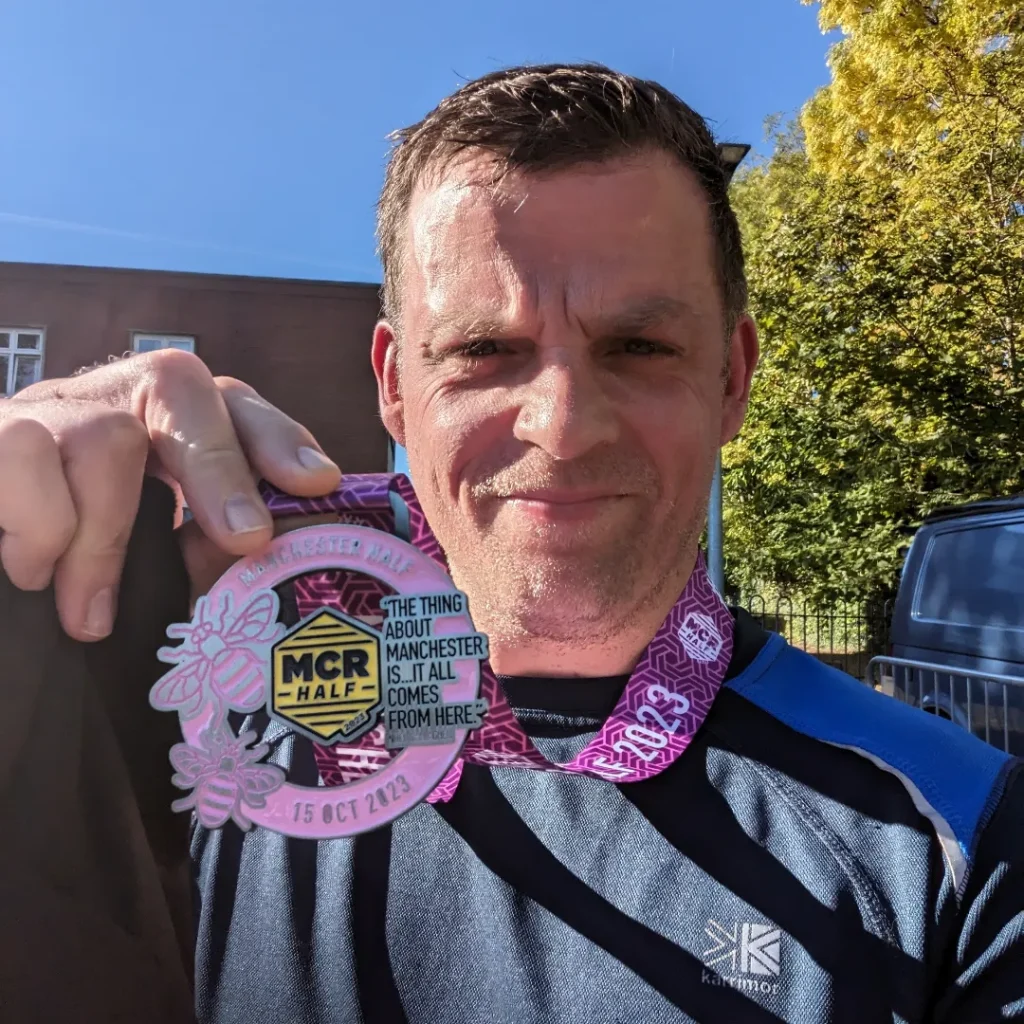
I put it down to barefoot running.
It’s a more efficient running style, and it’s easier to keep pace, once you’ve developed your leg strength.
My barefoot journey started 10+ years earlier.
Starting smack bang between two Tough Mudders which were 12 months apart.
If you’re not familiar with Tough Mudder. It’s an assault course set over 12 miles of rural land. And there aren’t that many obstacles so it’s 80% running.
The first one, towards the end of 2012 took me around 2 hours and 43 minutes to complete. I was happy with that.
Fast forward 6 months. And I’d gotten into wearing barefoot styles of shoes. With 6 months to go to the next Tough Mudder, I’d changed my training plan to focus on this event.
I’d trained for 6 months for my first Tough Mudder too,
But armed with my barefoot running shoes and trusty training plan.
I managed to knock a huge 40 minutes off my time. Completing my second Tough Mudder in 2 hours and 2 minutes.
And I put that down to barefoot running. Being more efficient, not burning through my energy. And developing strength through my entire legs and feet.
Years and Years of Wear & Tear
I started this article talking about the aches and pains. The wear and tear on our bodies from years of exercise. Trying to stay fit and active.
But having different stresses on our body from modern life. Sat at a desk for hours at a time. Or slumped on the sofa.
Even trapped inside modern clothing and footwear.
I’m no different.
I’d been playing football most weeks since the age of 14.
This had a massive impact on my body. So much so that at the age of 24. Every time I played 90 minutes of competitive football. The next few days were agony.
My lower back and sciatic nerve would go mental.
It came to a head one Sunday morning. My girlfriend at the time had to roll me out of bed because I was in too much pain every time I tried to move my legs.
The root cause for me was a weak core. Which after a lot of physio and focused work in the gym. I was able to manage.
But, I still had a lot of lower back issues into my early 30’s.
In my early 30’s I started to reduce how much football I played. But, I started getting into running.
Oh, and I’d always been a gym monkey. And hit the gym most mornings. I still do.
At the ripe old age of 32. My lower back was still very sensitive. But I’d also suffered from achy ankles. Again from years of playing football and now running.
I didn’t have much knee trouble. But did find I would get stiffness in my knees and they could be tender sometimes.
Aches And Pains Have “Magically” Disappeared
I switched to barefoot-style shoes back in 2013. At the age of 33.
You may think it’s because I switched so early that I’m reaping the benefit.
That could well be true.
But I only started running half marathons in my 40’s. And I find I can run 10 km more easily now than 10 years ago.
And that the aches and pains in my ankles and knees have gone. I have no foot issues either.
My lower back pain has gone too.
As I write this. The previous weekend my wife and I did a 21 km hike on Sunday. And yes, I’ve got a pair of barefoot hiking boots.
Guess what?
No stiffenness. No soreness, no aches and pains from the hike.
Yesterday I did a 9 km run. This morning completed a HIIT session barefoot. And I feel great.
The reason?
I’ve gone completely barefoot baby!
Conclusion: Start Barefoot Running If You’re Over 40
So. If you’re over 40 and already go running. Or, you want to start on your running journey now that you’re in your 40s
And if you’re looking to reduce the aches and pains you have from years of both exercise and office work.
I wholeheartedly recommend buying a pair of barefoot-style running shoes and giving them a try.
People think that we need supportive running shoes and to land heel then toe. But this is unnatural. We’ve spent 100,000 years evolving barefoot. Trust your feet and ankles.
Going “barefoot” will improve foot strength and flexibility. In turn improving balance.
And having good to great balance is proven to be a key marker for a long and healthy life.
It’s never too late to start. Again, you’ve got 10-20 years to improve your health and strength. that you will benefit from for the next 20-30 years.
Learn From My Mistakes
You need to do some prep work before going all in with barefoot running.
And don’t make the mistake I did and go “hell for leather”.
You’ll need to step back and take it slow. Design a plan so you get used to barefoot running.
But once you’ve got used to it. The speed that you will be able to run will get quicker. And you’ll find running further easier too.
So if you want to improve your running times and speed. As well as reduce the impact on your body. In turn, reducing those “aches and pains”.
Then I recommend switching to a barefoot lifestyle.
I’ve smashed many of my running goals well into my 40s. And the foundations of that have come from barefoot running.
Hitting 40 isn’t about slowing down and letting yourself deteriorate.
It’s about using years of experience and strength to get fitter and healthier too. You can do this by tapping into your natural abilities. Honed from millions of years of evolution playing to your advantage.
Make your friends and family wonder how you’ve become so fit and strong.
Your 80-year-old self will thank you too.
I hope you found this article useful and insightful. If you did. I’ve got a similar article that you may find useful: Awesome Yet Super Simple Morning Routine You Can Try